Then the righteous will reply, “Lord, when was it that we saw you hungry and fed you, or thirsty and gave you drink, a stranger and took you home, or naked and clothed you? When did we see you ill or in prison, and come to visit you?” And the king will answer, “I tell you this: anything you did for one of my brothers here, however humble, you did for me.”
Matthew 25: 37-40

I am beginning to understand what it must have felt like to be opposed to slavery in the U.S. after the passage of the Fugitive Slave Act in 1850. Effectively, the law required all citizens and officials across the nation to assist in the apprehension and return to their masters of slaves who escaped from the South. As illustrated painfully in Twelve Years a Slave, the existing situation was bad enough before this law, with free Black Americans subject to kidnappings and fraudulent sales into slavery by bounty hunters simply because of the color of their skin. That was in addition to the terror experienced by escaped slaves as they sought sanctuary in the underground railroad.
Sound familiar? An early September ruling by the sometimes ethically challenged U.S. Supreme Court lifted a lower-court ban on racial profiling by Immigration and Customs Enforcement (ICE) in choosing to detain and interrogate suspected undocumented immigrants. Speak Spanish? You’re suspect. Look black or brown? You’re suspect. Hanging outside a Home Depot? You may well be arrested. The ruling may be temporary until further cases play out, but the damage and the fear people face as a result are occurring right now without recourse. Your relatives may not find out whether or where you have been taken or under what conditions you are being detained.
How can I compare this current situation to the 1850s? Despite their strenuous insistence on states’ rights in maintaining a regime of white supremacy based on Black slavery, representatives of slaveholding states back then were so desperate to stem the tide of escaped slaves that they became total hypocrites on the subject. They chose to override states’ rights in using the Fugitive Slave Act to forcibly enlist unwilling and recalcitrant northern citizens in the morally loathsome task of recovering their lost “property.” The mindset behind this stunning inconsistency became crystal clear in the infamous Dred Scott decision in 1857, which stated that Black slaves were not citizens, had no rights that white people were bound to respect, and could not expect any protection from the federal government or the courts. The result was a highly predictable firestorm of indignation and opposition to slavery that led, within a decade, not only to the Civil War but to the Fourteenth Amendment, which established the citizenship of free Blacks and former slaves and anyone born in this country. The latter point, known as birthright citizenship, has been interpreted literally almost from the outset but is now a target of President Trump in an executive order that seeks to completely upend that interpretation.
It strikes me that we are revisiting this hypocritical stance and confronting the same sort of coercion and cooptation of conscientious objectors with the current all-out attack on immigration accompanied by sweeping violations of constitutional rights of anyone caught in the federal dragnet. The result is the same in the cities where this xenophobic campaign is underway. The forces of reaction and repression face growing outrage and increased resistance. The growing danger is that, after deliberately escalating conflict, Trump will find some flimsy excuse to impose his own version of martial law.
Here in Chicago, the evidence is clear that ICE and Border Patrol are using this playbook to demand the unwilling and recalcitrant silence or complicity of opponents of Trump policies in what are often illegal arrests and detentions of suspected illegal immigrants. The Trump playbook has always involved finding ways to compromise his adversaries and thus induce capitulation. This campaign relies on a noticeable degree of intimidation of legal resident aliens and, at times, American citizens who either protest or, in some cases, simply find themselves in the middle of an unexpected maelstrom. Yet many of the undocumented immigrants turn out to be utterly harmless or even dedicated and positive contributors to the life of their communities.
Threats to public safety? Violent criminals? One person arrested outside a Home Depot in Chicago was a tamale vendor. On another day, a flower vendor was arrested. He was later deported to Mexico. They are more likely targets of convenience to help ICE agents meet their daily arrest quotas established by presidential advisor Stephen Miller and the White House. Nonetheless, the Department of Homeland Security (DHS) repeatedly insists that it is removing “the worst of the worst” of “illegal aliens” from our streets as a justification for surging agents into predominantly Democratic cities like Chicago, Los Angeles, and Portland, Oregon.
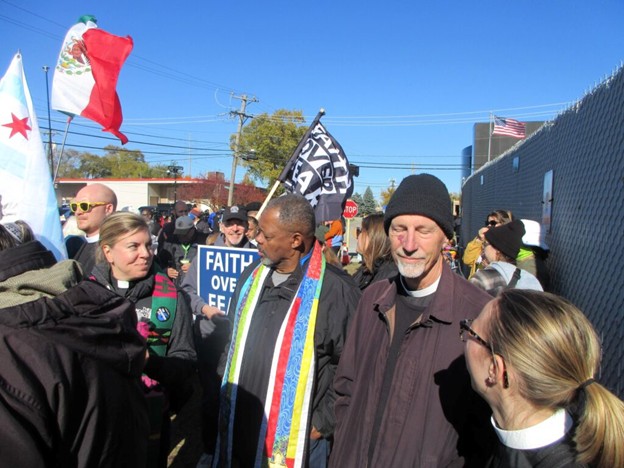
Just a Few Examples
- Doors were broken down by ICE agents at Joe Botello’s home in Elgin, a northwest Chicago suburb, on September 16, in an early morning raid accompanied by DHS Secretary Kristi Noem, who seems to relish appearing in social media videos produced by her department. Botello and five roommates were arrested, but he and one roommate were released in large part because they were U.S. citizens, a point he apparently tried to make even as he was being led away in handcuffs. On the way to the ICE processing facility in Broadview, a small western suburb, one agent asked Botello how he spoke such good English. “I’m a U.S. citizen and I was born in Texas,” he replied. One might wonder why it was necessary to bust doors instead of ringing a doorbell and presenting a warrant, but maybe it made better video. And who pays to repair the damage to Botello’s home? Good question. Maybe ask Noem. Such collateral damage and arrests became a signal feature of federal operations in the Chicago area.
- From the beginning of Operation Midway Blitz, ICE reportedly had been targeting Rico Fresh Market, a Logan Square neighborhood grocery store with a largely Hispanic clientele. On October 3, a Black Hawk helicopter and DHS vehicle were nearby, but various people in cars, on foot, and on bicycles boxed in the DHS vehicle, causing a masked agent on the passenger side to become agitated. Rather than calling for Chicago police to help clear their way, the agent began to throw tear gas out the car window. Aside from the lack of warning to the crowd, this clearly affected numerous passersby and customers, in the bargain forcing nearby Funston Elementary School to terminate outdoor recess for its children when a teacher saw the canisters being dropped. According to the Chicago Sun-Times, an organizer for the Illinois Coalition for Immigrant and Refugee Rights arrived at the store to find “a gentleman over there that was vomiting. There were people in the store nearby that were trying to get water in people’s eyes as soon as they can.” Outside Humboldt Park Health’s emergency room, where Chicago Alderwoman Jessie Fuentes was briefly arrested and detained for asking whether ICE had a warrant for a man who was being treated for injuries during an arrest, Fuentes denounced the actions as “violence” against the community she represents. I should note that, although I was elsewhere at the time, this incident caught my attention because it took place just two miles from my home in the adjacent neighborhood of Humboldt Park.
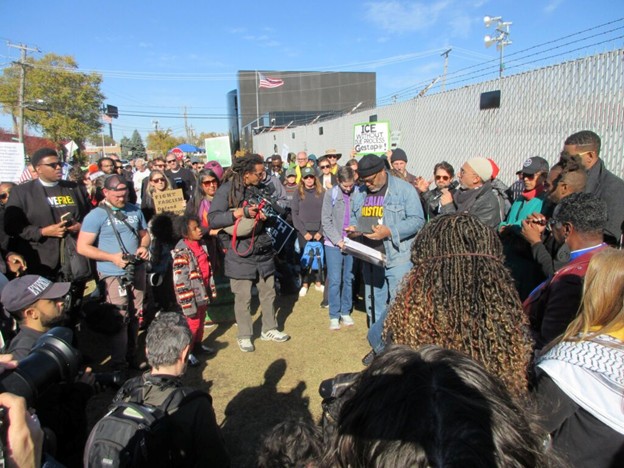
- In Broadview, protesters soon established a regular presence outside the ICE facility. Alleged conditions early on prompted sympathetic intervention on behalf of those being held there and against the aggressive tactics of ICE agents generally. The mayor, uncomfortable from the start with the high-profile ICE presence at a facility that had co-existed with her community quietly for decades until this year, demanded that ICE remove a fence the agency built around the facility that blocked access to parts of the community for village emergency vehicles. A federal judge agreed, and the fence was removed. But more alarming were the physically aggressive responses by agents to protesters, who generally seemed to comply with time-and-place restrictions imposed by the mayor to protect the peace of her own residents.
- Clergy began to arrive at the ICE facility for prayer vigils as they (and lawyers and public officials, even Sens. Dick Durbin and Tammy Duckworth) were turned away from visiting those being held inside, preventing them from seeing what conditions prevailed. In one incident that went viral, Presbyterian minister Rev. David Black was praying on the sidewalk when agents on the roof of the ICE facility (which Noem had also visited) fired five blasts of pepper balls toward him, some of which hit him in the face and knocked him to the ground. Clergy have also tried to gain entry to offer communion and spiritual support to detainees and been turned away. Recently, even Pope Leo XIV was moved to assert the need to allow detainees access to spiritual care and communion, to no avail.
- Conditions at the Broadview ICE holding facility were eventually detailed in a November 3 hearing by federal Judge Robert Gettleman for a class-action suit alleging inhumane conditions. Five former detainees, in sometimes emotional testimony, detailed crowded and unsanitary conditions and limited food and water. The judge found their testimony credible and issued a restraining order requiring specific improvements. It is worth remembering that most of the detainees have been shown to have no criminal record. Immigration violations, such as overstaying a visa, are civil offenses. Why mention this? Because DHS has repeatedly maintained that they are arresting “the worst of the worst,” which turns out not to be true in most cases.
- In one of several raids in Chicago’s heavily Hispanic Little Village neighborhood, Border Patrol Commander Gregory Bovino was recorded throwing a tear gas canister into the crowd of protesters despite a court order restraining such behavior and requiring two warnings to the crowd before such tactics can be employed. ICE and CBP agents seem not to take seriously the right to dissent and to protest, seeing such activities as a threat to law enforcement. But this is merely the tip of the iceberg. Federal agents have repeatedly used tear gas against peaceful crowds, in some instances, using them in neighborhoods with children and passersby present.
- ICE and Border Patrol agents seem particularly annoyed with citizens exercising their right to film enforcement actions in public spaces. They have arrested or threatened arrest of citizens using cell phone cameras for the purpose. In the parking lot of a Sam’s Club in Cicero, where Rafael Veraza and Evelin Herrera had come from west suburban Berwyn to shop, a string of federal vehicles appeared to be coming. Herrera pulled out her cell phone to record what was happening, but very quickly, a federal vehicle coming the other way fired pepper spray through their open window, with the spray hitting their one-year-old child in the back seat, who screamed as she shut her eyes in terror. Combine incidents like this with the ubiquitous use of masks by federal agents to cover their faces and conceal their identities, something local and state police cannot and do not do, and the result is a serious loss of public trust in federal immigration enforcement activity.
- As a result of all this, literally thousands of citizens and small business owners have acquired whistles, which are being passed out by neighborhood groups, to warn people of the presence of ICE and allow them to seek safety if needed and avoid arrest. The whistles have become almost a civic brand of resistance in both Chicago and its suburbs.
You Get the Gist
I could go on, and on, but I think most sensitive and thoughtful readers get the idea. One can argue fine points here and there, but I realize one can only stretch a blog post so far. There have been numerous major incidents I have not even detailed here, but the links can fill in a few of the blanks. Some day in the future, someone may well find material for an entire book about what has happened in Chicago in the summer and fall of 2025.
I have painstakingly created a bibliography of press coverage of the situation in Chicago newspapers between early October and Veterans Day, November 11, which I intend to post here in the very near future. My intent is to allow anyone who wants to dig more thoroughly to take this bibliography to their local library, or search online, to follow the trail, realizing that I have neither the time nor the energy to dip back into September or the summer months. The bibliography already stands at 13 pages. I hope it will prove a useful resource for those who may wish to study what has happened here.
Civic and Business Leaders Speak Up
It is a simple fact that chaos, including chaos created by government itself, has serious economic repercussions. On November 7, business and civic leaders met to denounce the arrest and deportation campaign conducted by ICE in the Chicago area. According to the Chicago Sun-Times, they noted that the raids had “scared people away from” restaurants, events, and retail stores with potentially significant impacts on the regional economy. Leo Sandoval, former CEO of the Illinois Chamber of Commerce and the son and grandson of Mexican immigrants, noted that Latinos comprise one-fifth of the state’s population, with a GDP of $100 billion. Yet the people being arrested, 70 percent of whom had no criminal convictions, were productive workers, farm workers, hotel staff, landscapers, and senior care workers, according to Rebecca Shi, CEO of the American Business Immigration Coalition. They are in part the victims of President Trump’s unwillingness, even as a candidate in 2024, to support bipartisan immigration reform because, apparently, he preferred a lingering crisis he could exploit to a resolution in which both parties had compromised. He preferred to terrorize communities that had not supported him and let ICE and CBP arrest people based not on any criminal record but on the language they speak, the color of their skin, and the nature of the work they do.
See You at “No Kings”

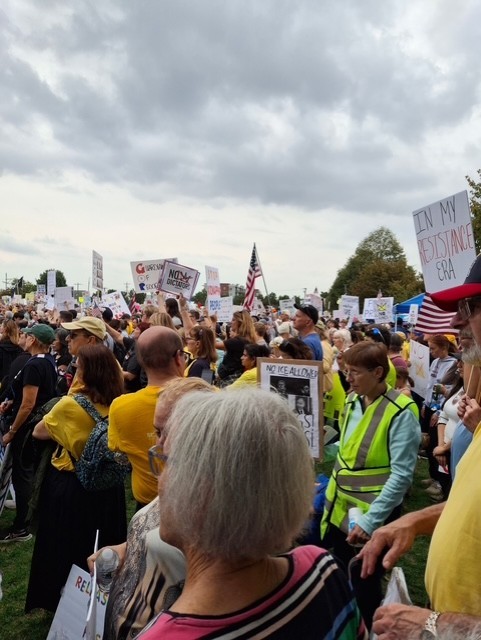
By October 18, Chicago area residents had seen and experienced enough. At the city’s first No Kings rally in June, which I attended at Daley Plaza, an estimated 75,000 people participated. That number is impressive enough, but the second rally in Grant Park’s Butler Field drew an estimated 250,000, nearly one of every ten residents in the city. The outrage at ICE and CBP tactics, personally experienced or otherwise, was palpable. At the end of the rally, as people marched toward the city’s iconic Buckingham Fountain, the crowd stretched across twenty-two city blocks. But this was not the only rally. Numerous rallies occurred in suburban locations throughout the metropolitan area, drawing additional tens of thousands of participants.
See You in Court
“The use of force shocks the conscience,” said U.S. District Judge Sara Ellis in her oral ruling on November 6 for a preliminary injunction concerning the tactics ICE would be allowed to employ in performing its job of immigration enforcement. Ellis had previously issued a temporary restraining order against, among other things, the use of tear gas and other chemical weapons before issuing warnings to protesters or other crowds. She had held hearings, allowed depositions, and found the government’s evidence of threats from protesters “to be simply not credible.” She found that Bovino had lied repeatedly in his deposition testimony about the use of force by himself and other agents in incidents throughout the Chicago area. She promised a written ruling to come but could not have been clearer about the dim view she took of the government’s position. As the Chicago Tribune noted the next day, she began by quoting Carl Sandburg’s poem, “Chicago,” which gave the city the nickname “City of Big Shoulders,” before describing her city as a “vibrant place, brimming with vitality and hope.” In her conclusion, she included a quote from Benjamin Franklin: “The freedom of speech is a principal pillar in a free Government: when this support is taken away the Constitution is dissolved, and Tyranny is erected on its ruins.” The federal government is predictably appealing her ruling to the Seventh U.S. Circuit Court of Appeals.
In the interest of open disclosure, I shall note, as a long-time member of the Chicago Headline Club, a chapter of the Society of Professional Journalists, that the Headline Club was the lead plaintiff in the suit, seeking protections for journalists and protesters against the aggressive tactics of ICE.
Meanwhile, in a separate case, U.S. District Judge Robert Gettleman ordered a series of improvements in conditions at the Broadview ICE holding facility, including “a clean bedding mat and sufficient space to sleep, soap, towels, toilet paper, toothbrushes, toothpaste, menstrual products and prescribed medications.” This begs the question of why a federal immigration enforcement agency should have to be told to attend to such business—instead of just doing it as a matter of course. This came after the testimony of former detainees noted earlier. Federal Magistrate Laura McNally subsequently indicated her intention to visit the ICE facility to verify the improvements.
Let my people go. On November 12, U.S. District Judge Jeffrey Cummings ordered the immediate release of 13 detainees on grounds their arrests violated the terms of a 2022 consent decree that limits what are called “warrantless arrests” that lack a judicial warrant or probable cause. More significantly, he told government lawyers to produce a list showing how many of 614 such people in a class-action suit were still in custody and whether any merited detention due to prior criminal history. By November 13, it appeared from the release of Justice Department records on these detainees that only 16, or 2.6 percent, had criminal records. The ruling could ultimately affect thousands of detainees held across the country.
I could detail several other cases in progress, but again, most readers probably get the idea. Some have involved release of people previously arrested, including the father of a young woman being treated for cancer, and some involved grand juries refusing indictments sought by the U.S. Attorney against protesters. Finally, and most significantly, the U.S. Supreme Court is set to hear appeals of a case in which lower-court judges blocked Trump’s planned deployment of National Guard troops from Illinois and Texas to the Chicago area. To date, that deployment has never happened, awaiting a decision from the Supreme Court.
The Big Picture
Chicago is a city born of intense and instructive struggles over time that Trump and the MAGA crowd have never mastered. It has grown from a small town to a world-class city by incorporating wave after wave of immigrants and migrants from every other part of the nation and the world. It has melded them into a working whole over two centuries and learned to lay out the welcome mat for more. It has grown and matured and overcome challenges and is still looking forward, not back.
From these struggles, its people have learned the value of interdependence among people of widely varying backgrounds—the immigrants, the descendants of slaves, the highly educated and brilliant, and the working class striving for a better future, whose strength lies in unions and family and courtesy toward others and lived experience. It is truly the city of broad and multi-colored and multicultural shoulders. We have reason to be proud of the city we have created.
People in Chicago are not stupid. They know how to respond to challenges like the occupation of their city by ICE and CBP. The real problem is that DHS did not study or learn about the city before launching Operation Midway Blitz. Chicago has a long history of effective community organizing. If the intent was to intimidate, it served the opposite purpose. It enraged, but with very few exceptions, people channeled their anger into nonviolent protest, no matter how malignly DHS chooses to characterize it. In their quest to create conditions that would justify their intrusion, ICE and Border Patrol officials are the ones who have engaged in deliberate provocation and violated laws and consent decrees and temporary restraining orders and have lied in court. As Rep. Delia Ramirez has stated about how they justify their actions, “They lie. Over and over and over.”
It is high time for them to leave. Unfortunately, they may not—soon, anyway. Like a punch-drunk fighter who is too dull to realize when he has met his match, they linger on. And on and on. But the fact remains: It is time for them to leave.
Word suddenly has it, as I finish writing this, that the feds are thinking of moving out, leaving a remnant of ICE and CBP personnel to maintain operations. Sources say they may return with more people in the spring. This comes shortly after the first lake-effect snowstorm occurred on November 9. Perhaps they lack the hardiness and stamina to face a Chicago winter. We can help them find good winter coats at Walmart as long as they spend their own money. But admittedly, winters are milder in the south, and we hear Bovino is headed for North Carolina. So, I have a farewell message:
We are a welcoming city. But if you decide to return in greater strength in the spring, do not expect us to roll out the welcome mat. You have already worn it out.
Jim Schwab
 Augustana Lutheran Church of Hyde Park
You must be logged in to post a comment.