This little silver box featured in Pastor Nancy’s Kids’ Time message during worship on All Saints’ Sunday. It is a reliquary, one of the artifacts that she interpreted this summer at the archaeological park at Jamestown in Virginia. It was found inside the bounds of the 1607 fort, and within the chancel of the first Protestant church building in North America, a small building that greatly resembled the barracks that John Smith built for the men nearby (the church was also the place where Pocahontas married John Rolfe in 1614).
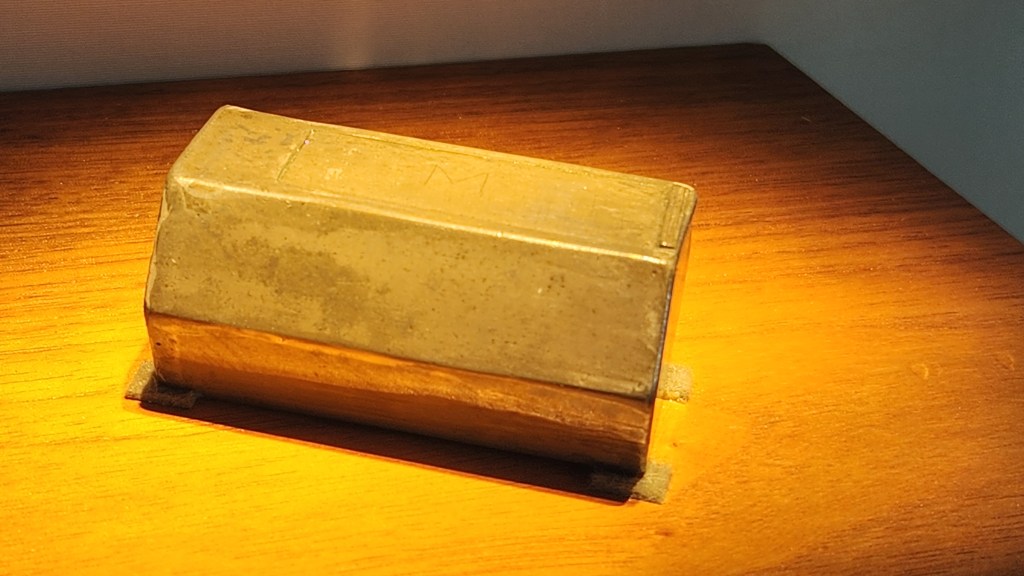
A reliquary holds saints’ bones, or relics. This one was found in the grave of Captain Gabriel Archer, one of the first Councillors appointed by the Virginia Company to govern the colony. He or someone he loved probably acquired the box on a pilgrimage to visit a church that could boast a saint from centuries before. The silver was mined in France or Spain, and the pilgrim must have made quite an offering if they bought the artifact and display box together from the church. In exchange, the pilgrim would have received a large indulgence, or assurance of pardon for sin and time off from punishment in purgatory.

Archer was buried under the chancel of the church, or the area around the altar, and this box was placed on top of his coffin before the grave was refilled. How can archaeologists know that? Because silver is naturally antibacterial, and sometimes bits of wood directly in contact with it can survive. Part of the coffin top was found below the box. The position indicates that at least one person knew that the captain was Catholic, and they were unafraid to put his box on top of his coffin, probably in front of others. Although the Virginia Company employed several men to keep tabs on events and record them, no one reported the box to the Company.
The Virginia Company often repeated their rule that no Catholics would ever be allowed at Jamestown. Henry VIII had led England out of the Roman Catholic Church in 1534, and over the next decades, Catholics were outlawed and suppressed. The anthropologists at Jamestown Rediscovery had long accepted the Virginia Company’s propaganda until the reliquary was found. It made sense that Captain Archer would be the one publicly identified as a Catholic; shortly before he sailed, his parents were arrested in England for “Catholic activity,” probably hosting a Mass on their estate. After the discovery of the box, many more objects that would have been dear to Catholic colonists were found at Jamestown, including saints’ medallions, rosary beads and crucifixes. Most of the men were of an age where their grandparents had grown up Catholic; it’s not hard to imagine that they passed along their beliefs as well as their objects of devotion to grandchildren, who brought them along on a perilous voyage.
When the box was found, conservators could not figure out a way to open it without breaking it. It had a door meant to slide, so that a devotee could remove the objects inside, but the door was stuck. After much debate about whether or not to sacrifice the object to find out what was inside, a CT microscan was performed. The result was so detailed that a replica could be made on a 3D printer of the bones and two tiny ampullae, or little lead flasks. These probably held drops of holy water or blessed oil or blood. Someday, new methods might make them accessible for study. For now, visitors to Jamestown just get to gaze on this beautiful artifact in the on-site museum.
 Augustana Lutheran Church of Hyde Park
You must be logged in to post a comment.